2022–2024
RC Business
At RC Business, a training company: sites that sell — capture, integrations and live operations.
- 14sites delivered
- 100 → 420visitors (Acelerador)
- 2/week → 2+/dayleads (Acelerador)
- 2integrations per funnel (capture + checkout)
Context
RC Business is a professional and managerial development training company, in Juiz de Fora, and it is where I started my career. I joined in February 2022 as a front-end developer and stayed until November 2024 — nearly three years in which I delivered 14 sites, almost all of them landing pages and capture funnels for the company’s own offers and those of partners around it: immersions, consulting and events.
This case is not about one site: it is about the pattern that repeated across those deliveries — and about the operation that kept them live after deploy. Two projects appear as examples below: the Dono Sniper immersion funnel (Acelerador Pessoal) and Alessandro Balbino’s consulting page. They are the ones with numbers, and they are still published.
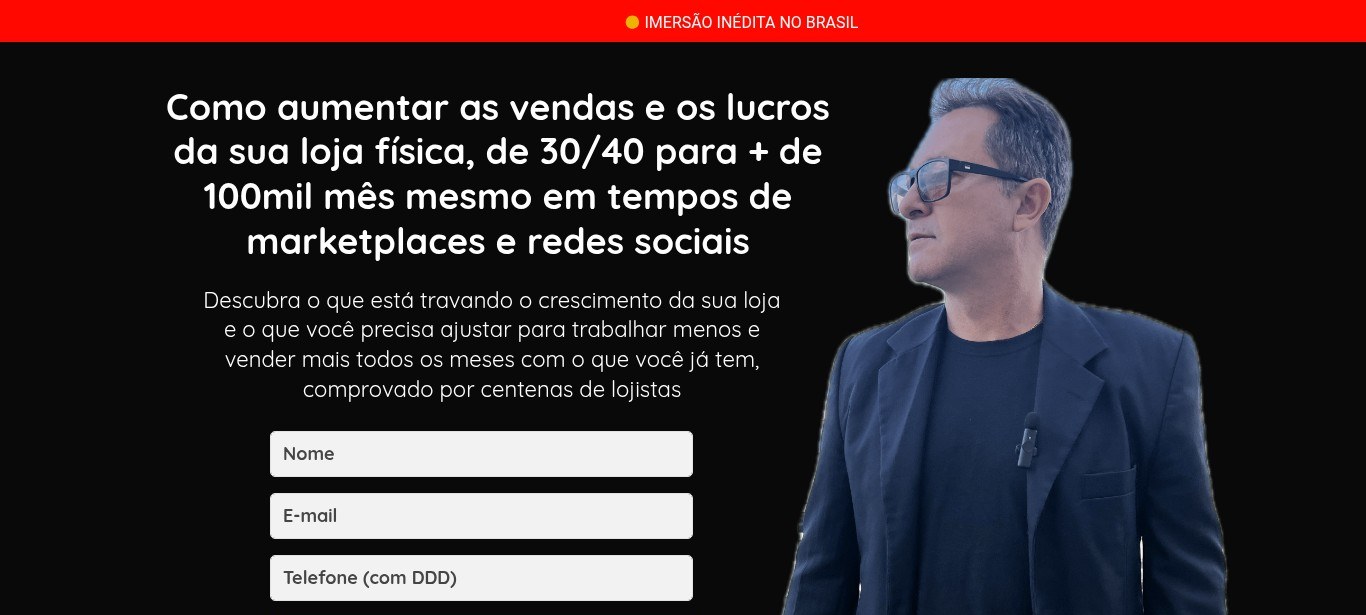
Example 1 — the top of the Dono Sniper sign-up page: headline and a three-field form.
The problem
The problem repeated under different names: an offer with paid traffic needs a page that captures, integrates and sells — on a short deadline, with content that changes every campaign. Each item below decided whether the campaign worked:
- entry friction: the audience arrives from social networks, often on a phone; every extra field in the form is one less sign-up;
- the lead has to arrive whole: name, e-mail and phone must land straight in the e-mail tool with the campaign origin (UTM) preserved — no spreadsheet in between;
- the sale does not live on the site: checkout must be reliable and handle payment, warranty and refunds outside the page;
- the obligations: privacy policy, a thank-you page with the next step, a custom domain;
- and the long page: an operation with several offers at once loses the visitor mid-scroll — section order becomes part of the work.
How it was built
The house pattern, repeated on every delivery:
- three pages per funnel — capture, thank-you and privacy policy — built on Builderall, with a shared footer and an anchor straight to the form;
- templates validated in earlier campaigns: the page structure and the section order had already brought leads in; the work was adjusting to each offer’s content, not redesigning the path;
- capture integrated with MailingBoss: name, e-mail and phone required, writing into the campaign’s list with hidden UTM fields, so every sign-up arrives with its origin attached and ready for the automations;
- Facebook pixels by behaviour: one pixel per kind of signal — pageview, lead and purchase — with subdivisions such as WhatsApp leads and form leads, so each campaign knew where a conversion was born;
mb_tag_matcher: a serverless webhook I wrote to match the lead’s classification in the CRM with the Facebook custom audience — the MailingBoss tag becomes campaign segmentation;- checkout through Kiwify: the page’s CTAs point straight at the payment, with nothing transactional inside Builderall;
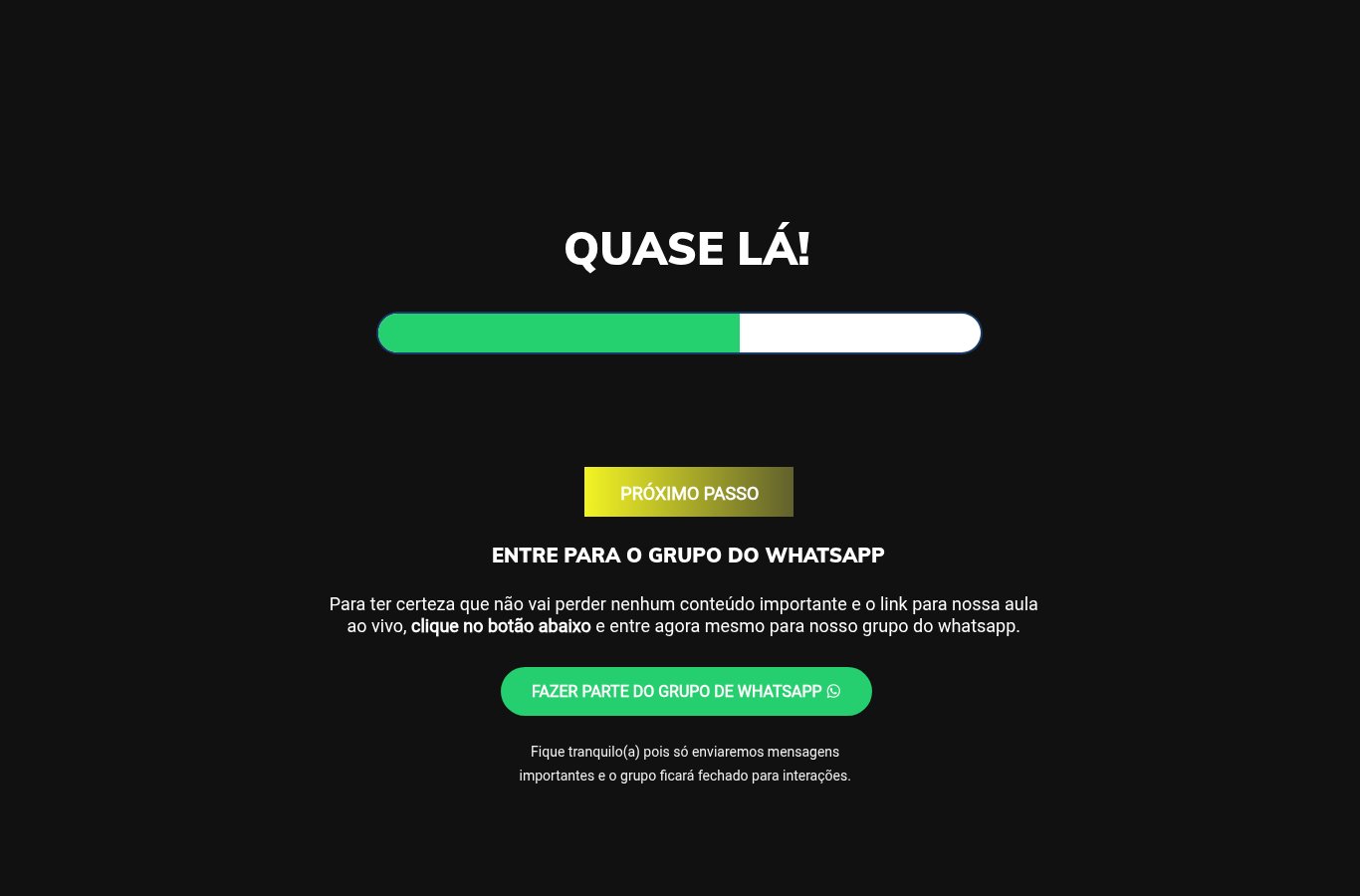
- a thank-you page with an explicit next step: progress bar and WhatsApp group entry — the funnel does not end at the form;
- a mobile layout configured block by block: it is where the campaign lands first.
Example 1 — Acelerador Pessoal (Dono Sniper immersion)
The funnel that went the furthest, and the only one where the campaign also passed through my hands:
- the ad creative and the ad itself were mine: the creative piece, the Facebook pixels created and the follow-up on the campaign that brought traffic to the page — the funnel starts before the form;
- result: 3 pages, 2 integrations, traffic from 100 to 420 visitors and leads from 2 a week to more than 2 a day.
Example 2 — Alessandro Balbino / AGMV Consultoria
A single-offer page of a different kind: no event date, but a service — the AGMV In-Company consulting.
- the service split into numbered modules: mindset, administration, management, digital marketing and sales — each block stating what the client’s team will learn; the numbering gives the scroll a rhythm;
- authority in the middle of the page: who Alessandro Balbino is — track record, book and honours — right after the modules, backing the decision to hire;
- mobile first for real: on a page this size, whoever arrives from Instagram scrolls a lot — the block-by-block adjustment is what decided the read.
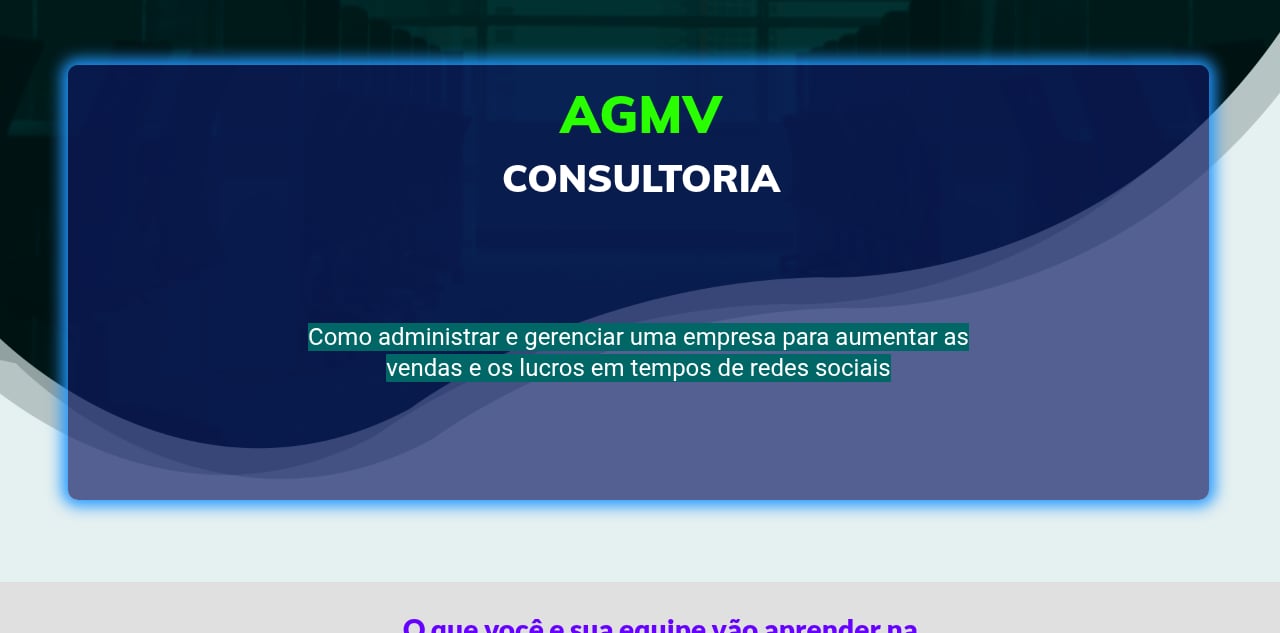
Example 2 — the consulting page: the modular offer and the authority of the person behind it.
Decisions and trade-offs
- Builderall instead of a hand-made page. Publishing and editing fast was worth more than full control: the content changes with every campaign, and the adjustment came out of the editor, not a deploy. In exchange, the layout stays tied to the platform and heavier than static HTML — a trade I would make again in that context.
- MailingBoss as the single source of the lead. The form writes straight into the e-mail tool, UTMs included, and the automations come already wired. Instead of capturing “by hand” and syncing later, the data is born in the right place.
- Checkout outside the site. Payment, warranty and refunds stay with a specialised platform (Kiwify); the page carries no transaction and no card data.
- One pattern per delivery, not a brand-new page per offer. The skeleton — capture, integration, checkout, thank-you — repeated, adjusted to each offer’s content, instead of starting from scratch every project; the time saved went into what was specific to the offer.
Quality and verification
This phase predates the verification discipline that guides the rest of the portfolio today, and it is worth being honest about what that meant across 14 deliveries:
- checking was manual, end to end in the browser: form landing in the list, thank-you leading to the group, checkout opening — desktop and phone;
- after deploy, operation was lean: hosting, domain, fixes and improvements straight in production, no staging;
- and the lesson from that phase became a rule in later projects: nothing ships without a way to verify it works. That is where the cost of not having one became clear.
Results
Nearly three years and 14 sites delivered — event landing pages, capture funnels and sales pages — two of which are still published and are the ones this case uses as examples. On the Acelerador funnel, the numbers moved with the work: traffic went from 100 to 420 visitors, and leads from 2 a week to more than 2 a day.
Beyond the numbers, it was the first real contact with the full cycle of a web delivery: build, publish, operate and improve after “done”.
What I learned
- A funnel does not end at the form. The next step — group, e-mail, checkout — is part of the design, not an extra.
- A pattern that repeats is delivery, not laziness. The same funnel skeleton, adjusted for 14 different offers, turned every new project into an adjustment instead of a restart.
- The right specialised platform beats custom code when speed is the goal: capture and payment went to tools that do just that, well.
- Operation is half the work. Publishing is the beginning; the difference between a good page and a page that sells is fixing and iterating after the traffic arrives.